


Bitumen Enamel
The Bitumen Enamel is based on specially selected bitumen which is modified by oxidation.
We are Iranian producer of bitumen enamel is a pipe coating products applied durable coating based on bitumen enamel which is a type of modified bitumen that has been successfully used for many years for corrosion protection of steel pipes.
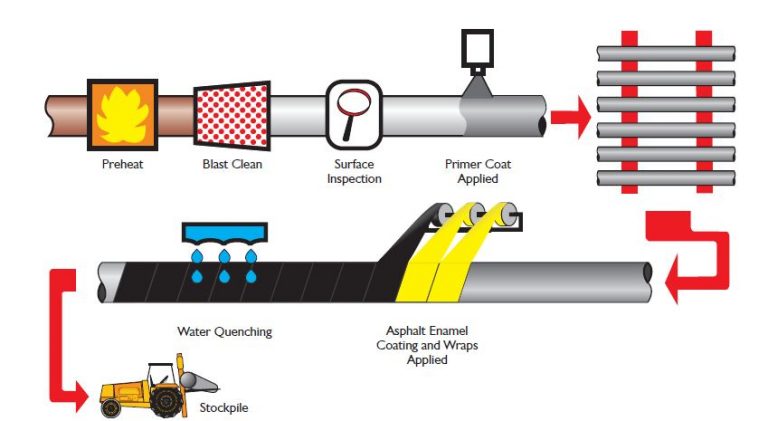
Application of Bitumen Enamel
It is applied to steel pipes, previously primed with Synthetic Primer, at 215-230°C. Also, one layer of inner-wrap and one layer of outer-wrap are used in this coating system.
Advantage of Bitumen Enamel.
- It has excellent adhesion to steel provides a track record of long-term corrosion resistance.
- It used for pipelines designed to the different application such as water, gas, oil or any other fluid when the continuous temperature of the fluid being transported does not exceed 70°C (I 58°F)!
- it is safer and more environmentally friendly system then coal tar enamel because of acidity of tar.
- Bitumen enamel pipe coatings with varying grades of bitumen enamel and inner and outer wraps along with a thickness as per your design specification.
- The enamel can be applied to various pipe diameters from 90 mm (3.5″) to over 1200 mm (48“).
- The enamel pipe coating bitumen based material is using for many years across the world.
How to use Bitumen Enamel?
BITUMEN ENAMEL should be broken up into small pieces and put into the kettle. Heat should be applied slowly until there is a quantity of melted Enamel on the bottom of the kettle. Kettles used previously for bitumen should be thoroughly cleaned before use.
The quantity of enamel remaining in the kettle from previous use should not exceed 10% of the fresh charge. The maximum temperature of Enamel in the kettle should never exceed 250 C and the Enamel in the kettle should be stirred constantly during the use. The normal application temperature of Enamel is related to its grade but it is normally between 220-240 C.
Enamel above this temperature should be rejected. Enamel should not be applied to the primer pipe when the metal temperature is below 7 C and care should be taken for the pipe is free from dust, oil, and moisture.
Storage
Heated Bitumen Enamel is to be stored under constant low-speed stirring. Storage temperature and duration depends on the Bitumen grade stored.
Standards
The Bitumen Enamel meets or exceeds all the performance requirements of EN 10300 Category 1, Grade b or c and AWWA C 203.
Quality Control
All raw materials for Bitumen Enamel are tested and approved in the laboratories of Merco BITUMEN Co. The quality of the finished enamel is controlled to either EN 10300 or the costumer’s specific requirements and a quality certificate is issued for each batch produced.
Delivery
Bitumen Enamel is available cold in 20 kg block or hot in bulk.
Technical Data of BITUMEN ENAMEL Type 1 Grade b
| Properties | Unit | Requirement | Method of test |
| Softening Point | ºC | 110 to 130 | EN 1427 |
| Penetration | 0.1 mm | 5 to 17 | EN 1426 |
| Density at 25 ºC | g/cm3 | 1.2 to 1.4 | EN 10300, Annex L |
| Filler Content | % | 25 to 35 | EN 10300, Annex K |
| Flash Point | ºC | Min 260 | EN/ISO 2592 |
| Sag at 75 ºC, 24 h | ºC | Max 1.5 | EN 10300, Annex D |
| Impact disbonded area @25ºC | mm2 | Max 6500 | EN 10300, Annex E |
Peel Initial / Delayed at 30 ºC 40 ºC 50 ºC 60 ºC | mm | 3 3 3 3 | EN 10300, Annex F, F.4.1 |
| Bend at 0ºC | ºC | Min 15 | EN 10300, Annex G |
| Cathodic Disbonding, Disbonded radius after 28 days | mm | Max 10 | EN 10300, Annex I |
Technical Data of BITUMEN ENAMEL Type 1 Grade c
| Properties | Unit | Requirement | Method of test |
| Softening Point | ºC | 120 to 150 | EN 1427 |
| Penetration | 0.1 mm | 5 to 15 | EN 1426 |
| Density at 25 ºC | g/cm3 | 1.4 to 1.65 | EN 10300, Annex L |
| Filler Content | % | 45 to 55 | EN 10300, Annex K |
| Flash Point | ºC | Min 260 | EN/ISO 2592 |
| Sag at 75 ºC, 24 h | ºC | Max 1.5 | EN 10300, Annex D |
| Impact disbonded area @25ºC | mm2 | Max 6500 | EN 10300, Annex E |
Peel Initial / Delayed at 40 ºC 50 ºC 60 ºC | mm | 3 3 3 | EN 10300, Annex F, F.4.1 |
| Bend at 0ºC | ºC | Min 10 | EN 10300, Annex G |
| Cathodic Disbonding, Disbonded radius after 28 days | mm | Max 10 | EN 10300, Annex I |